
The Estonian University of Life Sciences took part in the EPA 2026, held at the ERM on 14–15 October. The university presented its activities and collaboration opportunities and shared researchers’ expertise on current agricultural topics. The university was represented both at its own exhibition stand and in the Innovation Area, and also helped organize several discussion sessions.
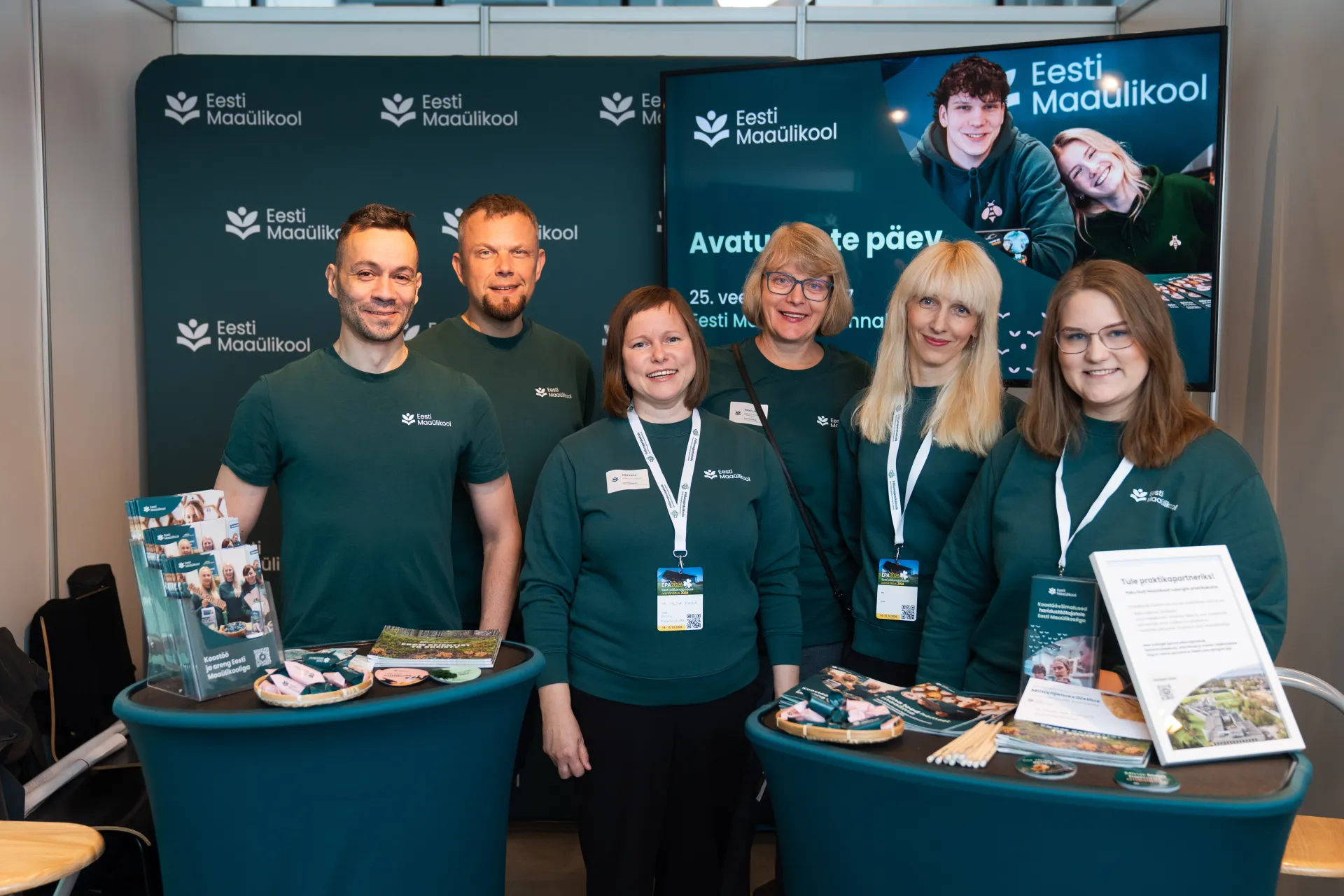
At the Estonian University of Life Sciences’ exhibition stand, visitors from businesses and other interested parties were introduced to the university’s collaboration and continuing education opportunities. In addition, the university co-organized discussions in the Estonian Agricultural Annual Exhibition Fair’s Innovation Area and participated in the area together with its business partners.
University Researchers Presented Crop Production Research and Collaborative Projects
At the EPA Fair, researchers from the Institute of Agricultural and Environmental Sciences of the Estonian University of Life Sciences shared their expertise on plant health, precision crop protection and sustainable crop production. Junior Researcher in Agriculture Triin Kallavus introduced innovative precision crop protection solutions and the potential of sniper technology, while Associate Professor of Molecular Phytopathology Kaire Loit spoke about the spread of plant diseases in Estonia. Chair Professor of Sustainable Crop Production and Head of the Chair of Crop Science Evelin Loit-Harro and Chair Professor of Plant Biology Tiina Tosens also took part in a discussion on One Health.
Evelin Loit-Harro and Senior Lecturer in Crop Science Indrek Keres organized a seminar conference on the Mini Cultivation Competition, bringing together the experiences, results and practical lessons learned from this year’s competition.
The Innovation Area also showcased collaboration between research and business. Priit Pramann, Head of the Polli Horticultural Research Centre, presented the centre’s collaboration with Kavilda Tomat OÜ, focusing on adding value to tomatoes and using production residues to develop new products.
Innovation Area Discussions Explored Data Use and Emerging Crops
During the Innovation Area discussion entitled “The Benefits and Challenges of Collaboration”, Hannelore Kiiver-Pärk, Board Member of Märja Experimental Farm, spoke about how technological advances have led to an ever-increasing accumulation of data on dairy farms. According to her, data exchange between official databases works well and has reduced the time farmers spend on administrative tasks. However, transferring data from herd management software remains a challenge.
Kiiver-Pärk encouraged farmers to make the most of the capabilities offered by existing farm management software and to enter data as comprehensively as possible. She also urged them to submit suggestions for improvements to both software developers and organisations that collect data.
In the discussion “Which Crops Will Become More Important as Climate Risks Increase?”, Peeter Lääniste, Senior Lecturer in Integrated Crop Production at the Estonian University of Life Sciences, recommended experimenting with sweet potatoes, durum wheat, sweet corn and millet.
“One of the factors guiding our choices should be the taste preferences of Estonians. Why consume food from abroad when it can also be grown here in Estonia? We are a nation of pasta lovers, and durum wheat is ideal for making pasta flour. The same applies to sweet potatoes, which have already become a familiar food on our tables,” Lääniste explained.
He added that millet is highly nutritious and gluten-free, making it suitable for many people's diets. While large areas of silage maize are grown in Estonia, sweet corn, which is suitable for human consumption, also grows well here and could be successfully marketed in Estonian shops.
One Health Discussions Focused on Crisis Preparedness
The Estonian University of Life Sciences also organized several discussions on One Health as part of the fair. The seminar “Estonia 2035: One Health or Multiple Crises? What Should Farmers, Researchers and the State Be Doing Today?” highlighted the need to improve preparedness for future crises.
Toomas Tiirats, Director of the Institute of Veterinary Medicine and Animal Sciences at the Estonian University of Life Sciences, who chaired the discussion, emphasised that the university had established its One Health Research Centre this spring specifically to support this objective.
Participants noted that last year's African swine fever outbreak also demonstrated that insufficient lessons had been learned from previous pandemics. Instead, crisis management often begins almost from scratch.
AIRE Discussion Explored the Potential of Artificial Intelligence in Agriculture
At the AIRE Club panel discussion “Advancing the Digitalisation of Agriculture through AIRE Demo Projects”, participants explored how artificial intelligence and robotics can help save time and costs, as well as improve efficiency in agriculture and the food industry. The Estonian University of Life Sciences was represented by Marku Lamp, Head of Research and Development Cooperation, who emphasised the importance of collaboration between universities and businesses and of scientific data collected over the long term.
The Estonian University of Life Sciences would like to thank all colleagues who contributed to organizing the university’s participation in the fair and represented the university at the exhibition stand, in the Innovation Area, at seminars and at other collaboration events.
Look also: Official EPA 2026 Photo Gallerylink opens in new page
Chief Specialist of Communications (Web Administrator)
+372 7313004
+372 7313004